INTERVIEW: Elesh Norn After Swords To Plowshares

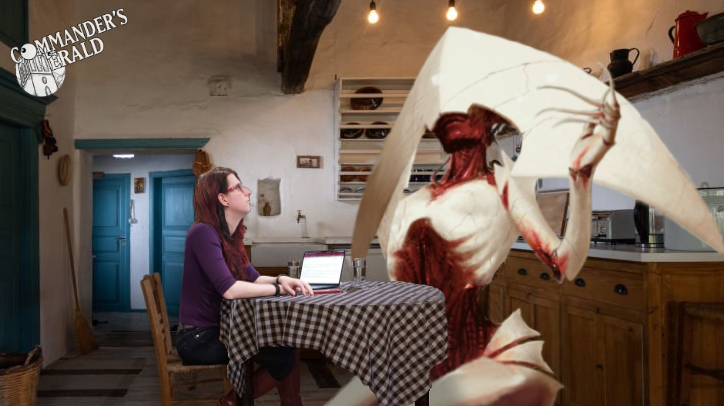
I stare out the window of the mud-caked pickup truck, my transition lenses blocking as much of the sunlight as they can while the endless plains slowly roll by. We’ve been driving for nearly half an hour, because this is the only way for a city girl like me, with no car, to get out to a location as remote as this.
At least I wasn’t given a permanent ticket. Unlike the person I’m here to see.
“You, uh, you sure about this, Miss?” asks my driver, his eyes still fixed on the road. But he sends a wary glance my way. “I reckon it’s kinda late to ask, but the lady who lives here is a little… eccentric.”
I give him a genuine smile. “I appreciate the concern, really. But I’ll be all right.”
He just nods back to me, not necessarily swayed. I cannot help but feel as if I am a parallel to Bram Stoker’s Jonathan Harker, on the last leg of his journey from fair England to distant and rural Transylvania.
As brave as Jonathan Harker ultimately was, I like to think I am more informed than he was, going in.
My driver parks outside the charming little one-story farmhouse. There isn’t so much of a “driveway” as there is a dirt lot, crisscrossed with tire tracks here and there. Another, equally world-weathered pickup truck, is parked a little closer to the house.
I pay my driver in cash I had prepared (though I was later told that they do actually take Venmo), pull out my earbuds, check my smart watch and discover that I’m a few minutes early, and hop out.
Instantly, my sleek block-heeled knee-high boots (the closest thing I had to appropriate footwear) become coated in mud, but I resolve to wash them off once I get back to the city. My driver takes off, having promised to meet me back here later this evening. I haven’t heard exactly when.
This is The Farm Upstate, where all sorts of lost and forgotten things go. Your childhood pet, your favorite toy, and, relevant to today, every Magic: The Gathering creature that gets targeted by a casting of Swords to Plowshares.
I step up onto the porch and ring the doorbell.
Nothing. It must be broken.
I try knocking, but the door is made of an old, thick wood that doesn’t carry sound well, if at all. I don’t want to shout for fear of seeming rude.
It’s only two minutes before I’m supposed to be here, so all I can do is sit around and wait.
But it’s not long before the door opens, and she steps out.
Nine feet tall, literally porcelain skin, spikes made of metal and bone with an underlyingly visible red musculature. I’m struck, even now, by her sheer visage–a thing I’ve seen everywhere in my career. No eyes, no ears, just a long, wide mask.
She has to stoop to make it through the doorway.
“Forgive me my poor hospitality,” she says, extending me a long, spindly, bony hand to shake–it’s nearly as long as my arm. “I’m afraid that there’s still no effect when you arrive.”
Turning on my famous autistic girl charisma, I give her a smile in return and shake her hand as confidently as I dare, ignoring the pain of something spiky that digs into my palm a bit. “No worries at all, I wasn’t waiting long. It’s a pleasure to finally meet you.”
Elesh Norn, former Grand Cenobite, former Mother of Machines, former Ruler of Phyrexia, just nods to me. She doesn’t wear clothes, but the mark of farm life is there all the same–wearing on her hands, dirt caked around her ankles, places where she’s shaved down the sorts of sharp edges that might get caught on tools or doorways.
She seems… older. World-weary. Maybe even a little softer.
She can tell I’m examining her. Even now, her “eye” (metaphorically) is a trained one, the kind that rules a kingdom, the kind that seeks betrayal.
“I’m Red, of the Commander’s Herald,” I say, as our handshake ends. “And… well. You don’t need to tell me who you are.”
She just hums. “What I have learned of your wretched flesh-creature hospitality tells me that I should invite you into my kitchen and offer you a beverage.” She steps back, her massive frame making way so I can see into the house. “Please, do come in.”
I heft my laptop bag over my shoulder and follow her inside.
It’s a humble place. I’m no major farming expert or anything, but the house is both spacious and cozy–a small kitchenette, circular wooden table with two chairs, a beaten-up old couch, a pretty small TV. There’s doors leading elsewhere, of course, but I’m reminded of some of the studio apartments I had on campus in college.
“You have a lovely home,” I try, hoping to establish a rapport.
“It is a paltry, sad excuse for a dwelling compared to the Fair Basilica,” she says, without embellishment. “Tea?”
“Just water is fine, thank you,” I reply, taking out my laptop and getting my phone ready to record. “We can start whenever you’re ready.”
She places a glass of water onto a coaster next to me and sits down, her frame nearly too large for the chair. Her legs–so long that they’re up to my torso, and I am far above the average height for a woman–have to be laid out to the side, as if she put them under the table, they would either hit mine or the bottom of the table. She looks like an adult sitting at a table meant for children, but somehow manages to make the entire affair seem somewhat dignified.
I hover my finger over the “record” button, raising an eyebrow at her to ask if she’s ready.
She just nods at me. “Begin.”
Interviewer: Elesh Norn, it’s a pleasure to meet you. Thank you for agreeing to this interview.
Norn: You are welcome, I suppose. I find my social calendar to be quite open, of late.
Interviewer: Well, yes–that is sort of the topic of our discussion, isn’t it? You were the target of a Swords to Plowshares a little more than three years ago, at the height of Phyrexia’s ascent to power. Now, thanks to that spell, you are the sole owner of this quaint little farmhouse.
Norn: Yes–I “own” it in the same way that a prisoner might own their cell.
Interviewer: You see this place as your prison?
N: I struggle to find another term for it.
I: Well, it is a farmhouse.
N: Do you find that a suitable dwelling for an individual such as myself?
I: [laughter] Well, you are a bit too tall for most of the furniture and decor.
N: That wretched spell is generally meant to target weak, squishy humans like you, yes, not a gloriously perfect Phyrexian.
I: You still think of Phyrexians as perfect, and humans as weak?
N: It is not a matter of opinion. It is a fact. Even as I perform these demeaningly human labors, I demonstrate my superiority. I do not sweat, I do not tire, and I perform feats of strength far beyond what your skinny, ugly musculature could manage.
I: Well, I won’t counter the fact that I am very far away from what anyone would consider “strong.” But do you think farm work hasn’t affected you, your body? I would disagree.
N: What are you implying, human?
I: Nothing more than the reality of what I can see with my eyes. You’ve had to grind down parts of your faceplate so you can fit through doors. The cape at your waist is gone now, because I figure it dragged and got caught on things. Your hands have been worn down from repeated contact with tools and things, much in the same way someone like me would get callouses. Do you think that that’s not evidence of change?
N: Merely an adaptation to circumstances. I have the ability to mold my own form to suit my needs. Should I ever find a way to escape this filthy place, I would gladly shed and replace the parts of my body that have been tainted by it. You, human, do not have that luxury.
I: Well…
N: What? Do not tell me that your kind have suddenly embraced radical body modification in the three years that I have been away. You are a creature of flesh and nothing more–your body grows only in the way that it chooses. I understand that you have precious little say in the matter.
I: [silence]
N: Why are you looking at me like that?
I: I, uh… this interview isn’t supposed to be about me.
N: Then spit it out and we can continue.
I: Well, you know how humans are loosely sexually dimorphous?
N: Vaguely. I find it all irritating and needlessly complex. Why is that relevant?
I: I used to be one of those sexes, and now I’m the other.
N: I… see. And you used bodily modification to accomplish this?
I: I mean, I had surgery if that’s what you’re asking.
N: And you changed only this? You did not discard your pale, weak flesh for the unflinching power of a machine?
I: I don’t think my insurance would have covered that. Hell, they only reluctantly paid for the surgery.
N: What is “insurance?”
I: I’m afraid that’s a topic beyond the scope of this interview. But I doubt you’d like it.
N: If humans created it, I believe you will be correct in your assumption.
I: Anyways, let’s get back on track. You had Swords to Plowshares cast on you three years ago. Can you tell me what that moment was like? Where were you when it happened?
N: You wish for me to relive the most infuriating and humbling moment of my life? You ask me to rip open my greatest shame and display it for you as some sick form of “entertainment” for your fellow humans?
I: Well, this is a press interview, so… yes. Pretty much.
N: You are lucky, human, that that Yawgmoth-forsaken spell removed my capacity to commit violence upon others.
I: Oh, absolutely. I would have died like three times already.
N: Four. I am keeping track.
I: Oh, lovely. For the record, it’s okay if you don’t want to answer. It’s just… you know. It sort of is the big thing to talk about.
N: Is it? You do not want to hear of my time tilling the fields, planting, harvesting? Tending to the pathetic bodily needs of my animals? Shoveling their excrement?
I: Not particularly, if it’s all the same to you.
N: Fine. If you must know, I was at the very height of my power, watching my forces take and compleat every plane in the Multiverse. It was glorious. At last, the ugly imperfection of all existence could be cleansed, made beautiful, perfect, and eternal, for the glory of Phyrexia. And I, the exalted Mother of Machines, was to stand at its head, only for that filthy peasant of planeswalker, Elspeth Tirel, to intervene. Just as we fought one another to a standstill, a light appeared and I vanished, finding myself here.
I: I see. And what did you do when you arrived?
N: I raged for some hours. Attempted to leave, to contact my servants, to return to my glorious empire. But there was no way out–and, as I understand it, there is now nothing to return to.
I: Yes. That empire was dismantled rather handily. One could even argue it was something of an anticlimax. The Aftermath of it all especially so.
N: It infuriates me to this day. My life’s greatest work, the single glorious purpose of all Phyrexia, gone in an instant thanks to a time mage, a dryad, and a pacifist.
I: You mean Karn?
N: Yes. I thought he would be proud of what I had built from the gift that he left us. I thought… that I could make him understand.
I: And you couldn’t.
N: No. He was rather horrified.
I: Did that ever make you wonder? Make you question whether what you were doing was right?
N: Of course not. One cannot afford doubts when they aim to rule the Multiverse.
I: That makes sense, I guess, but what about now? With three years of hindsight, have you ever stopped to wonder?
N: Wonder what, human?
I: Y’know. If the whole “conquer the entire Multiverse and take away everyone’s free will” thing was maybe not necessarily a good idea.
N: Of course not. I may resent the betrayal of my fellow praetors, but the glory of compleation, of Phyrexia, is a philosophy without flaw.
I: [stunned silence]
N: Speak, human. It is as if I have said something objectionable.
I: I’m just… I’m just gonna move right past that one.
N: Do you disagree?
I: Um, yes? Like, a lot?
N: Explain, then, human. Debate me on the merits of compleation.
I: What, like, for real? I mean… okay–permanently altering and brainwashing people without their consent is bad and wrong. Debate won.
N: But they are happy to be part of Phyrexia.
I: Yeah, because of the “brainwashing” part. Look, I didn’t come here to debate someone who is genuinely defending the merits of what is very clearly a writer fearmongering about things like transgender bodily autonomy–
N: What? What are you talking about, human?
I: It doesn’t matter. Look, we can just–
N: No. Explain your remarks.
I: [long, exhausted sigh] Look. Okay. I am going to describe the process of compleation to you–
N: I know more about the process of compleation than any being in any multiverse–
I: I know. Just trust me.
N: I will never do that.
I: [sigh] Just–listen for a second. Please.
N: Fine.
I: Okay. Thank you.
[pause]
I: The process of compleation involves a person being taken in by a frightening group of non-human entities and altered, irrevocably and nonconsensually, to become more like those non-human entities. They become very significantly a machine, a thing that lacks warmth or autonomy –yet they, previously dragged kicking and screaming into the process of compleation, will, after its conclusion, endlessly extol its virtues, to the point that–by their former loved ones–they become totally unrecognizable. A monster made from the body and soul of the person that their friends once loved.
N: A disgusting, human way to view the glory of Phyrexia.
I: Would you call it inaccurate? For that human perspective?
N: I have always been Phyrexian. I lack your human perspective.
I: And you’re incapable of empathy.
N: I do not know that word in your ugly human tongue.
I: Right. And remember how I said I used to be one gender and now I’m the other?
N: You claimed that this interview is not about you.
I: I’m trying, I swear. Regardless, that framework–the whole “the person I used to love is now different and horrible but they say they’re happy” bit?
N: Yes?
I: That’s how people who hate people like me describe what I did with my body.
N: … what?
I: I used to be a man–in their eyes, at least. Now I have “mutilated” myself to become a woman. I take hormones, I went under a surgeon’s knife, all to radically change who I was into who I now am.
N: There is no comparison. You have always been human, and you still appear exceedingly human, even mundanely so. The most remarkable thing about your form is that you are unusually tall.
I: Sure. But this isn’t an exact comparison, it’s a literary metaphor. The story of it, that’s all the same. “The person I knew got taken away from me and changed into something they’re not, and now their personality is totally different and they hate me” is something that can be said by both a friend of someone who got compleated and the transphobic parent whose transgender child rejected them for said transphobia.
N: Humans… discriminate against one another? For that pathetic, paltry degree of bodily modification?
I: Like you wouldn’t believe.
N: And they have the audacity to call me a tyrant.
I: Well, I would posit that brainwashing is still morally wrong.
N: They are happier, afterwards.
I: Sure, in the same way an iPad baby is when you give it the iPad. Like, I know you’re a machine ruler from another dimension and stuff, but come on. This was in Brave New World. It was in Wall-E.
N: Ah, I have actually seen that film on my “television.” It is such a tragic story. A benevolent machine almost fulfills its purpose, and then it is betrayed by faulty, unruly machines, and its human slaves are freed. I found poignant resonance with my own tale.
I: Is that… how you understand that story?
N: How else would one understand it?
I: I… hoo boy. How much time do you have?
N: To entertain your senseless blathering?
I: Fair point. I’ll move on with the planned interview.
N: A Phyrexian would have stayed precisely on topic.
I: You mentioned Elspeth Tirel, earlier. I wanted to ask about her–did you see her as your “greatest” enemy, of sorts? There was quite the colorful cast opposing you by the end of it, but one can’t deny the Elspeth of it all. Do you think of her as your main foe?
N: Absolutely. I hate Elspeth Tirel more than you have ever hated anything. The depths of my loathing for that woman go far beyond what any human could ever comprehend. She represents every wretched flaw and failure of your pathetic human experiment, your disgusting “free will” and your acceptance of imperfection. Each and every blow I exchanged with that vile angel, each time her foul blade dared to mar my perfect form, my hatred for her only compounded further. I recall our battle often, you know. More than any moment in my long life. I imagine myself fighting her, fighting her, fighting her, over and over again, and though the memory of my loss–of my failure–often creeps in, on my better days I can picture her losing. I can picture myself catching her sword and shattering it, seeing her broken at my feet. I step on one of those ugly golden wings as she tries to stand, I lean down and take her weak, fleshy chin in my perfect hand, and I whisper, “For the glory of Phyrexia” as the oil that I had prepared just for her starts to seep in.
I: …
N: And then, of course, she lives eternal at my side, an angel even more glorious than my Atraxa. A perfect consort for the Multiverse’s final queen.
I: Um.
N: Oh, what is it, you pathetic little creature? What idiotic, snide little thing are you going to say now?
I: You’re not going to like it.
N: That in and of itself would be not be surprising.
I: That’s fair.
N: Out with it, human.
I: Oh, um, it’s nothing, really–you just… you think about Elspeth a lot, huh?
N: My hatred for her consumes my every waking hour.
I: Uh-huh. Right. Hatred, huh?
N: Which ugly human word would you prefer? Loathing, disgust, disdain, malice–
I: Attraction?
N: What?!?
I: Oh come on. Seriously? That whole screed about what you fantasize about during your day to day? I might be a professional, but I’m also a lesbian, and I have eyes.
N: Eyes are a weakness. They make easy targets for foes, and are debilitating when removed.
I: They also tell me that you’re so obviously into Elspeth Tirel. You’re supposed to be the glorious machine empress, but you want her to wake up next to you every morning, don’t you?
N: I would have you killed for this slander!
I: Well, we’re actually printing it, so it would technically be libel. But unfortunately, to prove that in a court, you’d need to demonstrate that it’s false. And unless you want me to bring Elspeth here right now–
N: You can? You could bring that wretched angel here, to me, right now?
I: [laughter] No. She’s still really busy, I won’t be on her schedule until maybe Reality Fracture. But I got you going with that, didn’t I?
N: Are all human interviewers this senselessly cruel?
I: To the general public, maybe. But not to their interview subjects, I’ll admit that. These days it’s all about access, so basically nobody has the guts to actually interrogate anyone famous about the obvious lies and things they all tell. Fortunately for me, the Commander’s Herald is far more courageous–and knowing that the Swords to Plowshares spell prevents you from killing or even harming me is a big part of it.
N: I might yet loathe you even more than Elspeth Tirel.
I: Ooh, I’m flattered, but I actually have a girlfriend already. I think that about wraps it up for today–what’re we up to, now?
N: … what?
I: You said you were counting how many times you would have killed me. What’s the number now?
N: … I am afraid that a wretched, weak-minded human like you cannot comprehend the idea of infinity.
I: [laughter] Yeah, that’s more or less what I figured. Anyways, sign here to provide your consent for this to be printed?
N: You genuinely think I would allow even a word of this infuriating exchange to reach the ears of any other creature?
I: Do it and I’ll equip a copy of Elspeth, Storm Slayer with Luxior, Giada’s Gift so she can be targeted by Swords to Plowshares. I saw there’s an empty farmhouse next door.
N: [signs immediately] Get out of my sight, you loathsome little creature.
I: I’ll be sure to send you two a gift basket!
And that, dear reader, concludes my interview with Elesh Norn, three years after she was exiled by Swords to Plowshares. I will readily admit that we struggled to stay on topic, but this interview was hopefully an important part of her gradual reintegration towards becoming a more empathetic, tolerant person–er, machine. I rarely like to speak directly about such topics, but I will say that it was rather expensive for our head writer Zoe to target me with a copy of Cloudshift so that I would be able to visit Norn in exile until the end step and return safely. So if you enjoy journalism like this, please follow the Commander’s Herald and share our articles with your friends.
Until my next piece, dear reader. For now, I have a promise to keep.


