
Not That Kind of Cuffing – Comfort Commanders and What They Say About Us

Not That Kind of Cuffing
Comfort Commanders and What They Say About Us
Well hello there, dear reader. It’s been a while. Is it cold where you are? It sure is freezing here. We’re here today to talk about cuffing. And no, it’s not as dirty as it sounds. For those unawares, Cuffing season is a time when single individuals tend to fall into short-term, comfort based, relationships with the goal being having someone to cohabitate and exist with in the cold and lonely winter months.
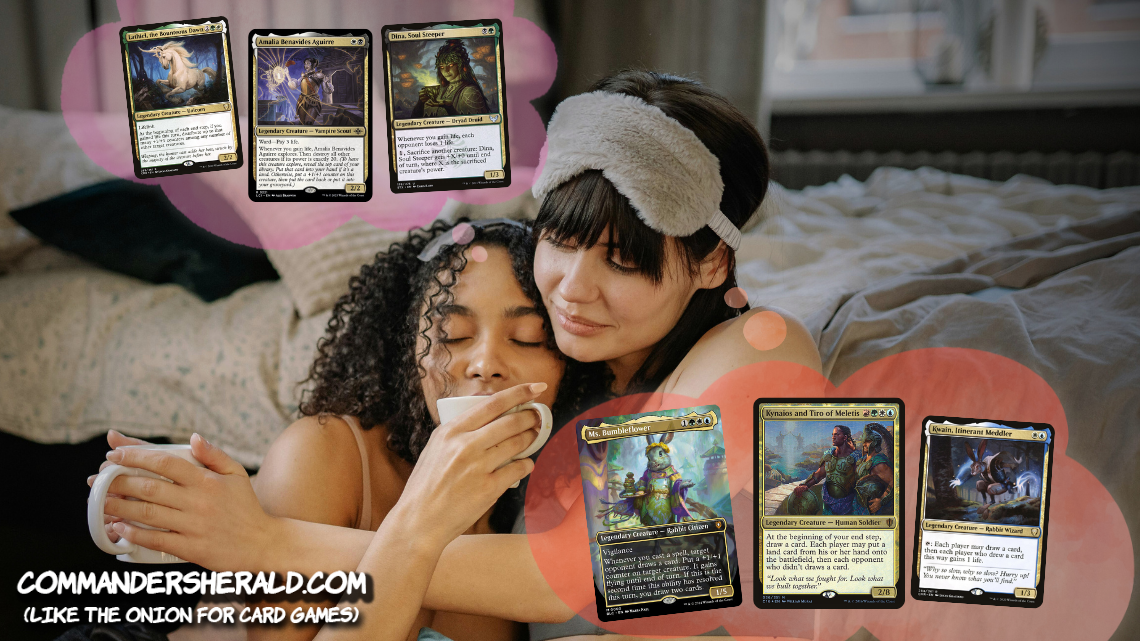
Now, unless you’re cozying up under a fluffy blanket with Ms. Bumbleflower every night, we’re not talking about that kind of cuffing.
Instead, we’re looking at how our humanistic cuffing instincts can translate to the games we play. It’s when you sit down at a Commander table, glance at the pod, and instinctively reach for the deck that won’t spike your heart rate or make you do brain work that you’re not ready for. Maybe the sleeves are a little worn. You know exactly how it behaves under pressure. You know what it does when it’s ahead, when it’s behind, and when the vibes are off.
Have I lost you yet? Does this sound silly and made up? Don’t worry, because when we take a step back and look at this through a psychological lens, this makes perfect sense.
Humans seek familiarity and predictability when stressed. This is an evolutionary phenomenon backed by decades of research on cognitive load, uncertainty reduction, and emotional regulation. Put simply- when the world feels volatile, scary, or really really cold, we gravitate toward systems where the rules are known and the outcomes feel survivable.
In Commander, that instinct shows up as a comfort commander.
So cozy in, get that warm drink close to your chest, and let’s learn together about how this game we love continues to serve us.
What Is a Comfort Commander?
A comfort commander isn’t necessarily leading your strongest deck. It isn’t always your most expensive, your newest build, or your most impressive one on paper. It’s the deck you reach for when your cognitive load is low, but your desire for connection is high.
If we look at this empirically, playing a game with a comfort commander can be an amazing self-regulation strategy. Familiar play patterns reduce decision fatigue. Rehearsed lines lower cognitive strain. Predictable outcomes restore a sense of agency.
In essence, these decks are emotionally legible. They let you participate without posturing. They allow for competence without performance.
And, I’m here to suggest that they say a lot about us.
The Caretakers: “I Like Knowing Everyone’s Okay”
Examples:
- Group hug commanders
- Lifegain value engines
- Pillowfort or enchantress builds
Ah- the pod mom. The responsible one. The one fitting into the “oldest daughter” archetype of familiar structures. If your comfort commander gains life incidentally, smooths variance for the table, or quietly keeps games from spiraling into misery, you’re likely someone that can struggle with empathetic overload. You’re highly attuned to the room, you read it as easily as a vanilla 2/2.
Really what we’re seeing is something called co-regulation: the instinct to manage your own emotional safety by stabilizing the environment around you. You don’t just play the board, you manage the vibes of the entire room.
Your comfort games thrive in the area where everyone gets to play or, “do the thing”. You’re not necessarily afraid of conflict, but emotional whiplash isn’t restorative for you, and when you need to relax, trying to guess if someone’s salt is real or playful is not the vibe. Your ideal Commander night ends with laughter, not salt.
You don’t want to control people to feel comfort. You want that feeling of tension free connection. Own it.
The Tinkerers: “I Feel Safer When I’m Doing Something”
Examples:
- Value-combo commanders
- Graveyard recursion engines
- Incremental advantage piles
My little busy bees; your comfort comes from motion. From knowing that even if you’re behind, you have lines. You have outs. You have decisions.
Research on anxiety and locus of control shows that people cope better with stress when they can identify actionable choices. The outcome is less important, you just want to feel like you had choices in what to do next. These decks hum instead of explode. They reassure you that helplessness is unlikely.
You’re the kind of player who doesn’t mind losing as long as you got to do, “the thing”. You like feeling clever, but not at someone else’s expense. Your deck reminds you that engagement itself can be a regulating experience, and there’s something deeply grounding about that.
The Ritualists: “This Deck Knows Me”
Examples:
- Long-term pet decks
- The deck you’ve rebuilt five times
- The one you always bring ‘just in case’
Do you have a stuffy from when you were a child? Maybe you have every Christmas card you’ve ever received, or a blanket from infancy that’s little more than a few threads. Some comfort commanders are less about mechanics and more about memory.
Personality psychology tells us that ritualized behaviors provide stability during periods of change. Familiar sequences like well-worn play patterns activate feelings of safety and continuity, even when circumstances shift.
This is the deck you played during a rough season. Or the one you brought to your first LGS. Or the commander whose lines are so internalized you could pilot it half-asleep.
You don’t just know this deck, you embody it. Everyone knows the game they’re in for when you bring it out. And in a hobby obsessed with novelty and 250 new commanders printed every year, there is something quietly radical about defaulting to an old reliable.
The Gentle Villains: “Let Me Be Bad, Safely”
Examples:
- Aristocrats with restraint
- Light stax
- ‘Mean’ commanders built responsibly
Alright my naughty babies. I know you’ve been waiting for someone to give you your attention and acknowledgement. Don’t worry, I’m only teasing. This is where I feel safe, too.
For us, our comfort commander lets us explore darker aesthetics without crossing our own lines.
Psychologically, this mirrors one of my favorite concepts known as shadow integration. It’s why S&M is so popular. It’s engaging with aggression, control, or transgression in ways that are bounded and intentional. Your deck becomes a safe container for impulses you don’t want leaking into real-world relationships.
You like control, but not cruelty. You like power, but not humiliation. Your deck gives you permission to be sharp, spooky, and a little indulgent, but it’s within limits you trust yourself to respect.
This isn’t about dominance. It’s about containment. It’s about cracking the lid every so often just to let a little naughtiness out.
Why Comfort Commanders Matter
For many, commander isn’t just a game; it’s a social ritual. A grief ritual. A regulation tool. A way of saying, “I’m here, and I want to engage, but be gentle please”.
Your comfort commander is the deck you play when your nervous system needs a win condition. That’s not something to be embarrassed about. If anything, it’s a sign that you know yourself. And in a time period where everything is really scary, that can be a nice win.
So just remember, my lovely reader, you’re not cuffed..you’re grounded.
“But Dr. Foxglove, this sounds ridiculous. It’s not that deep!” Maybe you’re right. But in a world where nothing makes sense, let’s let ourselves play and imagine a little bit. You deserve it.
So tell me, what’s your comfort commander? What does it say about you?


